Why I'm Writing About This
I'm probably not the only one surrounded by a strong push to increase productivity with AI at work.
And honestly? I'm a fan. I don't think a day goes by without me asking AI for input, researching, editing, thinking through tasks. It's a big time-saver.
But then I look at some of the things I actually do as an internal PM. The messy enterprise environment. Where history has been built on history. Where spaghetti architecture is barely understood by the people who built it.
And I start wondering... how long would it take AI to actually replace that?
That question is what sent me down this rabbit hole.
What AI Is Already Good At, And Where It Falls Short
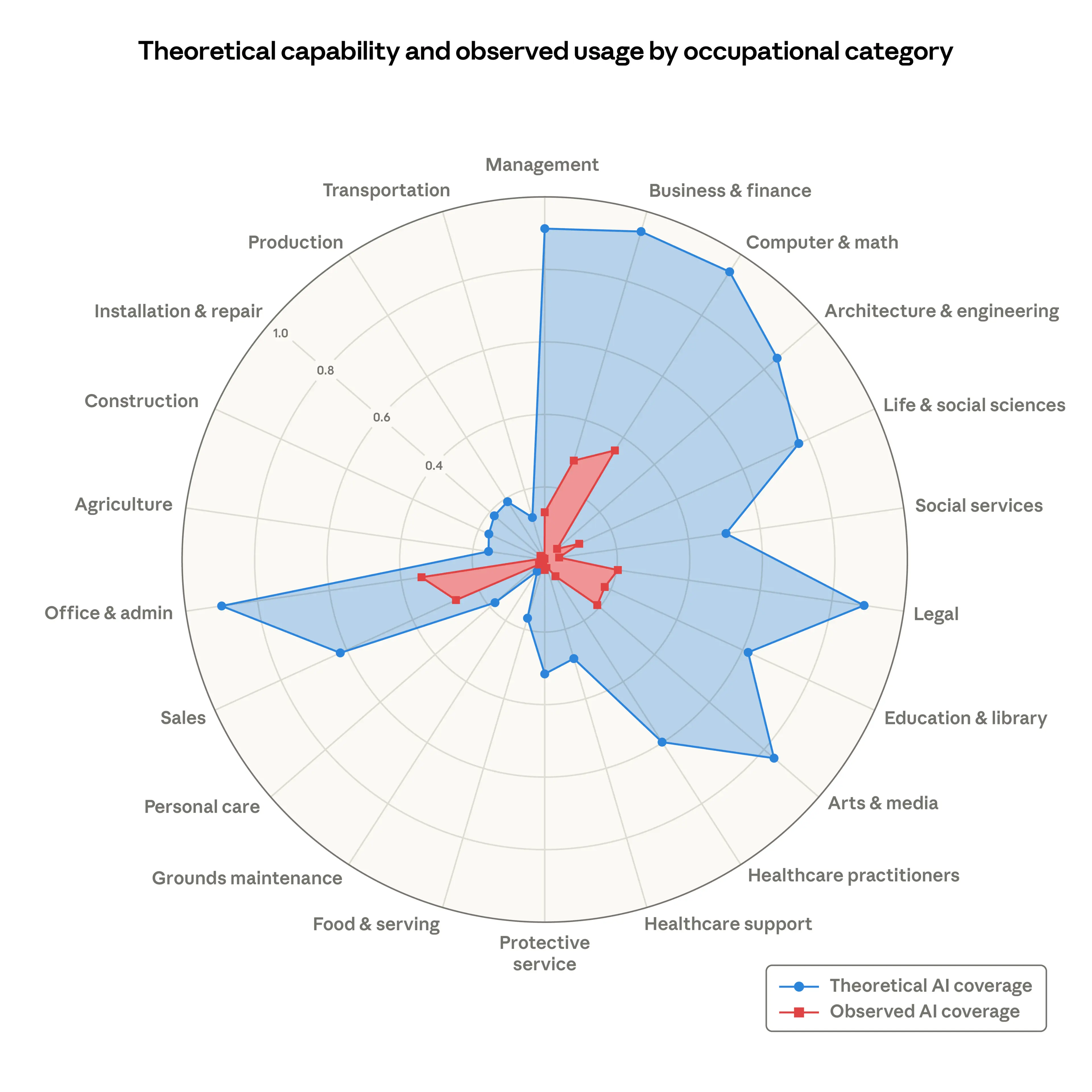
Anthropic (the company behind Claude) published a study in March 2026 comparing what AI could theoretically do versus what it's actually being used for in professional settings.
The gap is massive. Management and business roles have 94% theoretical AI capability, but only 30% is being used in practice. Architecture and engineering? 85% theoretical, only 5% actual. Product managers aren't even in the top 10 most-exposed occupations.
On paper, AI could speed up most of what we do. In practice, it's covering a fraction.
Source: Anthropic, "Labor Market Impacts of AI," March 2026. Read it here
Can AI Replace Internal Product Managers?
Let's be fair. There's a lot AI can already do, and some of it overlaps with our jobs.
What AI is already good at (or getting good at fast):
→ Development: generate prototypes, write code, run tests, ship features in hours instead of weeks
→ Quality and monitoring: scan for vulnerabilities, catch bugs, detect anomalies, alert teams before users notice
→ Design: generate UI mockups, suggest layouts, create full design systems
→ Documentation and communication: draft PRDs, status updates, release notes, summarize meetings
→ Research and analysis: crunch usage data, synthesize feedback, run competitive analysis at scale
→ User support: handle first-line tickets, classify issues, route to the right team
That's a real list. And it's growing.
But here's the big IF. All of this works when your technology is modern. Clean architecture, documented APIs, structured data.
Some tech-first companies are already going all-in. Klarna cut its workforce by 40%. Shopify told teams to prove why a job can't be done by AI before hiring. Duolingo launched 148 AI-created courses in under a year (the first 100 took 12 years).
Except... then they walked it back.
Klarna admitted the all-AI approach produced "lower quality" and started rehiring humans. Duolingo's CEO clarified AI is not replacing employees. Even with modern stacks and massive budgets, full replacement didn't work.
And most of us don't work at Klarna.
We work where the architecture is 20 years old, systems are connected with duct tape, documentation is nonexistent, and data lives in 17 places that don't agree. Before AI can do much here, someone needs to clean it up. Modernize. Migrate. Decouple.
That someone? Often it's us.
BCG's April 2026 study found that 50 to 55% of US jobs will be reshaped by AI in the next 2 to 3 years. But only 10 to 15% are vulnerable to actual elimination. For most roles, AI augments the work. It doesn't replace it.
So what would AI need to figure out to actually replace an internal PM?
→ Navigate spaghetti architecture that's barely documented
→ Build trust with stakeholders who don't even trust each other
→ Make judgment calls when data is incomplete, conflicting, or nonexistent
→ Run a meeting where half the room disagrees and no one says it out loud
None of this is structured. None of this lives in a database.
And that's the irony. The messy, human, context-heavy work that makes our job hard is exactly what keeps us relevant.
Sources: → BCG, "AI Will Reshape More Jobs Than It Replaces," April 2026. Read it here
How the Industry Might Change: 3 Hypotheses
Hypothesis 1: Dev teams shrink. PMs become builders.
AI handles more coding. PMs prototype, automate, ship features themselves. I've already lived this with Make.com, Lovable, and Claude. The catch? This works for new, simple products. Not for enterprise systems built on 20 years of legacy decisions.
Hypothesis 2: PMs become AI orchestrators.
Today you coordinate between design, engineering, and QA. Tomorrow you also coordinate between AI agents that draft PRDs, monitor production, and handle support. Someone needs to decide which AI does what and course-correct when it's wrong. That sounds a lot like a PM.
Hypothesis 3: The PM role splits in two.
BCG's research shows AI doesn't just shrink roles. It splits them. Track A: the builder PM who ships fast and works closer to code. Track B: the strategic PM who owns stakeholder relationships and business cases no AI can make.
What all three have in common:
You need to work with AI. And the human skills become more important, not less. The PMs who thrive will be the ones using AI to free up time, and spending that time on the work only humans can do.
So… What Am I Doing About It?
I'm not panicking. But I'm not sitting still either.
→ Everything I do at work, I look through the lens of: how can I automate this with AI? First partially. Then fully. That's how I think about every repetitive task now.
→ I'm doubling down on the parts of PM that AI can't replace. Stakeholder relationships, organizational context, judgment calls in messy situations, business knowledge.
→ I'm staying curious. The data changes fast. What's true today might not be true in 12 months.
Do not cut human skills. Double down on them. They're the ones that will matter most.